
Olympia Yarger
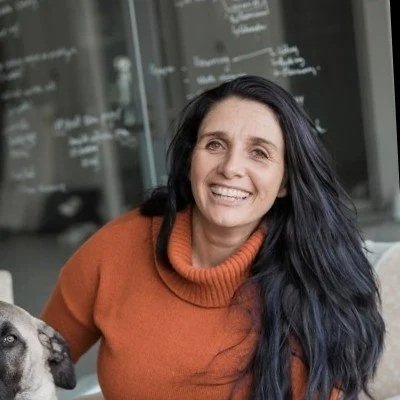
Farming pioneer
Through her agritech start‑up Goterra, Yarger has built a waste‑management system that’s as strange as it is effective: portable maggot robots that house black soldier fly larvae, turning food waste into fertiliser while the larvae themselves become protein‑rich feed for livestock and aquaculture. It’s a closed‑loop solution that behaves a little like a worm farm, but at industrial scale — and with far bigger climate implications. So far, Goterra has processed more than 35,000 tonnes of waste and prevented over 66,000 tonnes of carbon emissions. For Yarger, it’s proof that the future of sustainability might just belong to the smallest workers in the shed.
As the founder of the Insect Protein Association of Australia, and the namesake of a newly identified soldier fly species, Hermetia olympea, honoured by the CSIRO, Olympia has become one of the country’s most recognisable champions of insect‑powered innovation.
In this interview, we talk about Goterra’s inception, the importance of technology for sustainability, and the impact it has had on waste management.
SEE Change: Can you tell me how you first got into working with insects and food waste — was there a moment that sparked it, or did it evolve over time?
Olympia: Mostly it was just about alternate protein for agriculture. It's been an evolution as to how we farm them, but it was just the search for agricultural feed that got me here.
When you were first starting Goterra, what were some of the biggest challenges in turning such a new idea into a working business?
I think one of the things that I think we're really thinking about is “How do you consider what the future needs?” So you can easily get stuck trying to solve today's problems and believing that that's what the future will be, but what building Goterra taught me was that you have to actually think about what's going to happen tomorrow and build the business to actually solve for that. That's been the greatest lesson I've learned.
CSIRO named a fly species after you by — what was that like for you?
It’s one of my proudest moments because it feels like you've done something important. It's something that makes you really proud.
Your system processes large amounts of food waste and turns it into protein and fertiliser. What impact do you think technologies like this can have on climate and waste systems more broadly?
The fact that you don’t need to spend as much on petrol is a big part of it, but the real value is that you’re creating fertiliser and feed right in the region where it’s going to be used. That local loop is one of the biggest assets. Those are the kinds of things that matter most as we move forward. The modular nature of what we’ve built, and the way it fits into the world, is probably the thing we’re proudest of. It’s simple, it works, and it’s set up to keep moving in the right direction.
For people who want to start engaging with circular systems in their own homes or communities, what are some simple, realistic starting points?
No, it’s not really a mindset thing. It’s an economic choice. If people want to save money on managing their organics, then we’re a pretty important and impressive option. If they want stronger circular‑economy outcomes, better emissions reporting, or better ESG performance, we can deliver that too. And the thing is, you don’t actually need to change anything you’re already doing to use our system — it’s an easy win. So, yeah, the system isn’t trying to be perfect. It’s trying to be clear and simple. What’s the value proposition? If it’s environmental, we answer it. If it’s economic, we answer it. If it’s both, we can help. That’s the best part.
Looking ahead, how do you see insect-based technologies shaping the future of sustainable food and waste systems?
It really depends on how the whole space develops. Insects themselves aren’t the point, they’re just one type of technology. What actually matters is that we build more capacity for recycling and organics processing. Those needs aren’t going away. So any business that’s genuinely addressing that gap is going to be valuable into the future.
After building Goterra and working in this space for a while, what’s something you’ve learned about how people respond to new environmental technologies?
People get excited about new environmental tech, so there’s definitely an appetite to engage with it. But in practice, what we see is that it mostly just gives them a processing option they didn’t have before. It fits into their business, it solves a problem, and then they get on with their day. They don’t overthink it. It’s more like,” Oh, we’ve got a better outcome now. Great!” And that’s about as far as it goes.