Lucy Ridge
Politics of food
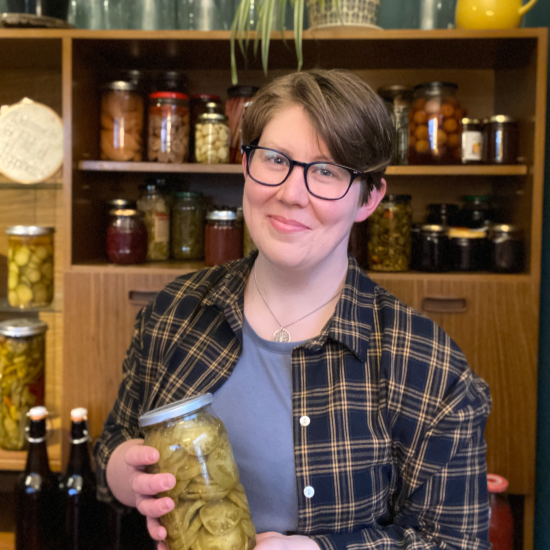
Lucy Ridge is a food writer and former chef with a passion for food sovereignty and feminism. She loves making meaningful connections over a meal as well as promoting local and seasonal cooking. Now she spends her time writing about the food and hospitality industries in Australia. Since 2020, she’s been on a journey to understand more about food in Australia by learning from women working across the food and beverage industries — travelling and taking on multiple internships. She also heavily interacts with the music industry, being a part of several music groups such as the supergroup Lucy Ridge & The Derby Widows.
I recently had the chance to speak with her about the shift from chef to storyteller, the women who have shaped her understanding of food, and the deeper connections she’s found along the way.
SEE Change: You’ve worked as a chef for over a decade — what first drew you into cooking, and how did that relationship with food start for you?
Lucy Ridge: It started with my mum. My mum loved to bake. So we kind of did it together. And whenever I helped in the kitchen, I got to sneak in some bites which as a kid was fun. Those moments made cooking fun for me and since then I have loved cooking
You often talk about food as something that creates connection between people. What does that look like for you in practice?
For me, food has always been about bringing people together. I grew up in a family where meals were a communal thing. Everyone gathered, everyone shared. The act of eating together felt almost sacred in its own simple way. Even little traditions, like saying cheers or breaking bread, carried meaning. They reminded us that food isn’t just something you eat; it’s something you experience with people. That’s the part I’ve carried into my cooking. I love creating moments where people feel connected, even if it’s just over a really good plate of food.
Since moving from working in kitchens into writing and food commentary, how has your relationship with food changed?
It’s changed a lot, honestly. When you’re working in kitchens all day, the last thing you want to do when you get home is cook for yourself. My diet back then was pretty rough, mostly because I was exhausted. Stepping out of that environment gave me time and energy again, and now I actually cook really well at home. I enjoy it in a way I couldn’t when I was doing twelve‑hour shifts.
The other big shift came from working with Southern Harvest and the local food co‑operative. I’ve been spending more time with small‑scale growers across the region, and it has completely changed how I think about food. Things like the Southern Harvest multi-farm produce box scheme and the CSA model show how much work farmers carry on their own. When you take distribution off their backs, it makes a huge difference. We’ve had around 150 households sign up, which is incredible. Seeing that kind of community support has made me appreciate food not just as something delicious, but as a whole system of people, labour, and care.
Over the past few years, you’ve travelled and done many internships across Australia to learn from women in food and hospitality. What was that experience like for you?
It was honestly life‑changing. I started travelling and doing internships because I was feeling a bit disillusioned and needed to reconnect with why I loved food in the first place. I wanted to learn from different women in different parts of the industry and who were approaching food in ways I hadn’t seen before. Food has always been my passion, but I realised I wanted to work with it differently.
The biggest shift for me was discovering agroecology and food sovereignty. I suddenly had vocabulary for things I’d felt for a long time but didn’t know how to articulate. Food sovereignty isn’t just about food security; it’s a whole way of thinking about food systems. It’s about sustainability, ethical production, community benefit, and making sure producers actually have agency in the system. It also looks at the environmental impact and the social structures around food, not just whether people have enough to eat.
Learning from women who were already working in those spaces completely reframed how I see food. It made me realise that food isn’t just something we cook or eat. It’s political, it’s cultural, it’s environmental, and it’s deeply connected to community. That experience changed the direction of my work and how I want to contribute to the food world moving forward.
How would you say your personal relationship with food influences the way you see the food industry more broadly?
My personal relationship with food has definitely shaped how I see the broader food industry, mostly by making me realise just how messy and complicated it really is. When you care about food on a personal level, it’s hard not to notice the ways supermarkets, monoculture farming, and large‑scale systems prioritise profit over people. Australia produces so much food, yet so many Australians still struggle to access enough of it. A lot of what we grow gets exported, and the system is designed to benefit CEOs and corporations rather than communities.
That’s pushed me to look for alternatives, because our future depends on it. But working against such a powerful system is difficult. There’s regulation, legislation, and consumer habits all reinforcing the status quo. Food has become a commodity and a convenience item, and the true cost of producing it (the environmental damage, the economic strain on farmers, even the impact on our wellbeing) gets completely externalised.
There’s also this idea that local food is automatically expensive, while corporate food is cheap and accessible. But when you dig deeper, you realise farmers have been sold a lie, that GMOs and chemicals would make everything easier. Instead, the land becomes dependent on those inputs, and “rehab” for the soil is both expensive and essential. Seeing that up close has changed how I think about food systems entirely.
So my personal relationship with food — the joy, the care, the connection — makes me want an industry that reflects those values. One that supports farmers, protects the environment, and actually feeds people well. It’s made me more hopeful, too, because once you see the problems clearly, you can start imagining better ways forward.
You’ve written about feminism in relation to food and hospitality. How do those ideas connect in your own work and experiences?
Feminism has always been part of my relationship with food, even before I had the language for it. I was first taught to cook by a woman (my mum) and yet when I entered the industry, I realised very quickly that most of the power still sits with men. Hospitality is still incredibly male‑dominated. You see it in the alpha kitchen culture, the hierarchy, the way the head chef sits at the top and everyone else falls in line. Historically, it hasn’t been a welcoming space for women.
And it’s not just kitchens. Across the broader food and agriculture sector, women have been doing the work without being recognised for it. Farmers’ wives weren’t even counted as farmers in Australia until 1994. Land is still mostly passed down to male heirs, which means women are less likely to inherit farms or have access to the resources needed to run them.
But here’s the thing: women feed the world. Globally, women make up a huge proportion of the agricultural workforce. They grow food, they cook food, they manage households, they hold communities together, and yet they often have the least access to land, education, and decision‑making power. Once I learned that, I became fascinated by the different perspectives women bring to food and farming.
When someone is excluded from a system, they often see it differently. Women tend to approach land and food with a different mindset: more collaborative, more open to learning from other cultures, more willing to listen to Indigenous knowledge. That’s something I’ve seen again and again in my internships and travels.
Even in my own life, I’ve watched how cooking can be both a creative outlet and a chore. My mum loved cooking, but she also carried the weight of it. That duality is part of the feminist story too: the joy and the labour, the creativity and the expectation.
So for me, feminism and food are completely intertwined. My work is shaped by the women who taught me, the women who weren’t recognised, and the women who are reshaping food systems today. It’s about making space, shifting power, and valuing the people who have always been feeding us.
You’ve said that eating is a political act. What does that actually look like in everyday life for people who might not think of food that way?
I think eating is a political act because everybody eats and that means our choices carry weight. Every time we buy food, we’re putting our money somewhere, and that creates a kind of political currency. If we stop thinking of food as just a commodity or a product, it becomes a really powerful way to influence the world around us.
That doesn’t mean people need to overhaul their whole lives. Even small changes matter. Just pausing to think about where your food comes from, how it was produced, and who benefits from that system can shift things. When lots of people make small, thoughtful choices, it adds up.
A good example is the huge campaign around battery hens. People learned about the terrible conditions hens were kept in, and they pushed for better standards. It was a legitimate, grassroots movement, and it had a tangible impact, not just on animal welfare, but on what people wanted to eat and what the industry was willing to supply. That’s everyday politics. It’s people saying, “We want something better” and the system having to respond.
So when I say eating is a political act, I don’t mean it in a heavy or intimidating way. I just mean that food is one of the simplest, most direct ways we participate in shaping the world. And the more aware we are of that, the more power we have to make things better.
You’re part of Lucy Ridge and the Derby Widows. Does your music connect back to your work in food and writing, or does it sit as a separate creative space?
Music is a really important creative outlet for me. Being part of Lucy Ridge and the Derby Widows has given me a whole community in Canberra, and that’s something I really value. When you work in food or writing, it’s easy to get tunnel vision, so having another space where I can express myself and let out my emotions is essential. Some of the songs I write are even about the issues I see in the food world, especially around how women are treated, so there’s definitely overlap.
But it also stands on its own as another passion. When you’re fighting for change or working in social justice spaces, it’s easy to get bogged down in the negativity of it all. Music brings joy back into the picture. It reminds me what we’re fighting for, not just what we’re fighting against. It’s nourishing in a different way. So even though food, writing, and music are separate parts of my life, they all feed into each other and keep me grounded.
After everything you’ve explored across food, writing, and music, what’s something about food or hospitality that you keep coming back to or thinking about?
The thing I keep coming back to is that food is political. That’s the biggest lesson I’ve taken from everything I’ve done: the internships, the travel, the writing, the community work. Once you see food through that lens, you can’t unsee it. It shapes how I live my life and how I show up in my jobs.
If more people approached food that way, I genuinely think things could change. Because food isn’t just about what’s on a plate. It’s about systems, power, access, labour, land, and who gets to make decisions. Understanding that has grounded everything I do. It’s the thread that ties all my work together, and it’s the idea I keep returning to no matter where I go next.