
Tim Hollo
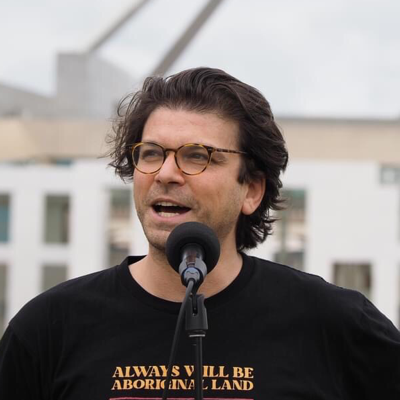
Advocate, campaigner, writer and organiser
Tim Hollo is a passionate advocate, campaigner, writer, and organiser. He has dedicated his work to building a more just and sustainable future through the lens of ecological democracy. As the former Executive Director of The Green Institute, founder of Green Music Australia, author of Living Democracy, and a member of FourPlay String Quartet, his work spans politics, music, and community action.
In this interview, we speak with Tim about the ideas that drive him, the role of creativity in change, and why ecological democracy matters now more than ever.
SEE Change: What experiences in your own life made you question whether our current political systems are sustainable?
Tim: There's no easy short answer to that. I would say the main experience is accumulated experiences over 25 years. The mythology of our political system is that if there is good evidence that a certain action needs to be taken, then our political system can take that evidence and act appropriately. We've known about the climate crisis and the ecological crisis for a very long time, and action by our political and economic system is still heading in the wrong direction. And it seems to me that we can't just say, “Oh well, we just haven't quite gotten it right yet and the system will somehow work it out.” It must be fundamentally a structural problem.
That's the broad answer. There are also narrower and specific answers. One of them for me was that I was a staffer for the Federal Greens for Christine Milne in the mid-2000s, when climate action was very, very much on the political agenda. We'd had the IPCC and Al Gore winning the Nobel Peace Prize. John Howard was defeated by the Labor Party, and Kevin Rudd swept in promising decisive climate action, calling it “the greatest moral challenge of our time.”
And what happened? The federal Australian government had all the power needed, but continued to trumpet the fact that they were committed to climate action while simultaneously funding and expanding the coal industry. And the experience of being a staffer for the Greens, attempting to negotiate decent outcomes for the climate with a Labor government that was promising action on climate change, but fundamentally refusing to do any of the appropriate things that needed to be done, was a particularly stark example of that.
To avoid sounding overly partisan, I should say this: I am a long-time member of the Greens, and I’ve also seen the party achieve genuinely important things, especially here in the ACT. Getting the ACT to 100% renewable electricity is a fantastic achievement. So is pushing the government to reconsider automatic gas connections for new developments.
But on another level, when you stop and think about it, it kind of does your head in that this is the most progressive jurisdiction in one of the most progressive countries in the world. This is a wealthy, prosperous jurisdiction, which has had a long time to get used to the idea that climate change is a real thing. And we're celebrating something which is a tiny win, instead of acting at the scale required. Climate change is so serious that we need to phase out our entire use of fossil fuels in the next 10 years at the absolute outside. And we're only just having this conversation that maybe we shouldn't continue to expand the industry.
And we don't seem to be able to have a conversation about getting off petrol. We have the highest uptake of EVs in the country, but we're still having a huge expansion of people driving those massive monster vehicles. Even in Canberra, where we have everything in our favour, we're not doing anything like what needs to be done. And Canberra is about as good as it gets.
How does your environmental and political work intersect with your music?
I've always believed in the power of music and the arts to drive social change. As a teenager and young adult, I was a big fan of a whole lot of political singer-songwriters — Billy Bragg, Sinead O'Connor, Rage Against the Machine — even going back generations to figures like Bertolt Brecht and Kurt Weill from the pre-Nazi period. There has always been an element of the arts that has been engaging in social change and and the need to act.
For most of my life, my musical and political paths ran alongside each other without intersecting much. I’d make political statements on stage and talk about political issues when performing, but it was only really after that point, when I became a staffer and we managed to get the Gillard government to act reasonably well on the climate crisis, only for Tony Abbott to be elected and undo so much of that progress. I burned out on politics, and in that moment of crisis I founded Green Music Australia, which is still going strong today. The idea was to deliberately bring those two parts of my life together and say: the music scene needs to play its part.
What really pushed me in that direction was something I heard repeatedly from musicians. They’d say, “I don't feel like I've got any authority to talk about climate issues when I know I'm part of the problem. And it’s true, unlike, say, Sinead O'Connor talking about feminism and Irish nationalism or Billy Bragg speaking from working-class experience.
That’s where Green Music Australia comes in. The aim is to help musicians and the music scene to reduce waste and energy use. Lower transport emissions, and start becoming part of the solution. And by engaging musicians and the music scene in this process, we realise we can be legitimate advocates on this issue just like anybody else.
Festivals, venues, and large events have always been a part of major social movements, from civil rights to feminism to LGBTQIA+ rights. But this is a specific kind of approach that says we need to focus on sustainability as well.
How do you see ecological democracy contributing to the long-term sustainability of our current political systems?
Well, I don't, to be honest. I see it contributing to the evolution and transformation of these political systems into something completely different. Our existing political and economic systems are built on domination. They're very hierarchical, and they rest on forms of separation; the separation of humans from nature, the binary separation of men from women, and the separation of white men from everyone else. We can see that in the adversarial nature of our politics, where we assume that politics is about fighting instead of conversing, collaborating, or bringing different ideas together.
There’s a huge body of literature around it and a whole lot of work being done around grappling with the idea that we've got to let go of that separation. We've got to recognize that we humans are animals embedded within an ecosystem. Our bodies are literally ecosystems in their own right. More than half the cells in the human body don’t contain human DNA; they’re microorganisms. Our bodies are constantly changing. That is ecology. And we need a democratic system that reflects that ecological reality.
That’s what the book is about; the idea that we don’t just need to reform our political systems. We need to transform them. Completely. If we’re going to survive, we need systems that reflect interdependence rather than domination; connection rather separation. And I absolutely believe that we can do that. People sometimes say to me that's a bit scary or depressing that we need to act to such a great extent. But to me, it's actually a very liberating idea. Most people can feel that our political systems are failing to deal with the climate and ecological crises. Even if they can’t articulate it, they can sense it. And that’s why the vast majority of people are deeply depressed about the state of the world and about the climate crisis and the ecological crisis. But if you recognise that these systems were invented by humans, we can reinvent them, dismantle them and put them back together again in a completely different shape. That's entirely up to us. We can do that if we choose to. And for me, that’s where hope comes from.
Tipping points can happen in all sorts of ways in all sorts of different directions. And organisations like SEE Change is part of that process edging us closer to that tipping point in the right direction.
Have you seen any best examples as how this kind of democracy was done in practice, aside from natural ecosystems and our own bodies?
There’s a lot of powerful space opened up by First Nations systems of governance. That’s where I get a lot of my ideas and thoughts from. People like Professor Mary Graham, who's a Wakka Wakka/Kombu-merri woman from Southeast Queensland, have written a lot about First Nations relational systems of governance.
A core principle in these systems is interdependence. We can't make decisions solely for the individual, but they’re not made in a way that erases the individual either. Every collective is made up of individuals, and every individual is a member of a collective. Every First Nations people is a collective of collectives who are also interconnected with other peoples.
There's a model that I find quite inspiring, although I have my differences with it, from the American anarchist Murray Bookchin. In The Ecology of Freedom, he developed this concept called municipal confederalism. Interestingly, this model is being use in parts of Kurdistan, where communities govern themselves collectively, send delegates to regional councils, and then to larger coordinating bodies. It’s a multi-layered governance system involving several million people, operating across semi-failed states in Syria and Iraq, yet functioning in this extraordinary manner.
There's also a lot of work done by the Nobel Prize winning economist Eleanor Ostrom about governance of commons. And she has many examples of how local communities manage to self-govern very effectively using understandings of interdependence fundamentally and collectively developing the rules by which they agree to be governed, changing those rules as needs, working effectively in cooperation.
So there are numerous examples, and in some ways, they’re flourishing precisely because our existing system of government is failing.
Flexibility is also crucial. The willingness to change is something our political system doesn't like. That's the third aspect of it that I talk about in the book: separation, dominance, and the illusion of permanence, this pretence that things can just keep being the same.
What's the biggest barrier with Australia in allowing ecological democracy to take root?
That's the million-dollar question, as they say. I think there are two big barriers which are fundamentally interconnected. One of them is that being open to change, even if you've got all of these great ideas about what it might look like next. It requires us to be willing to let go of things we've long been committed to. And that is really hard for humans, in general, and even harder when life feels uncertain or difficult. We don't like to let go. And it's undeniable that for many of us, particularly in a country like Australia, this political system has “worked” well enough for most of us. We know it won’t continue to work in the face of climate change and rising fascism, but it's still difficult to let go of.
I've been doing a lot of thinking about this and actually am just starting a PhD to kind of really dive into that particular question of what it will take for us to actually let go.
The second barrier is time. And there's two aspects to time. One is the sense of urgency that we have, particularly about climate change, which is entirely legitimate. It is incredibly urgent. And when something's incredibly urgent, there's a feeling you've just got to work with the tools that you've got, which are liberal democracy and capitalism, even though we've demonstrated very clearly that those tools are not going to work.
The second aspect is that capitalism is designed to keep us working constantly, so that we need to participate in the market. The busier we are, the more we need to buy. We don't have time to grow our own food or even cook our own food, so we use Uber Eats; we don't have time to make our own clothes, so we buy fast fashion. The way capitalism deprives us of time is a central part of this because self-governance takes time.
If Australia were to ever embrace this ecological democratic principle, what do you think our political system and community life would look like in 20 years?
I think Australia would look radically different, but it will also depend on the community you're in. One of the fundamental principles of ecological democratic philosophy is that healthy ecosystems thrive on diversity. You won’t have the same model in every community as each community will work towards its own model in its own direction.
For instance, I live in leafy inner-urban Canberra, on a street with a whole lot of standalone homes with gardens. There's a particular approach that we could take in our community which would be quite different from the approach that you might see in inner metropolitan Sydney or Melbourne, where a lot of people live in large apartment buildings without any land, with a whole lot of anonymity that goes with that. And you'll need to make different structures of governance to enable these communities to find their own paths forward. These structures will have to overlap and allow for give-and-take.
For example, the fact that I have that I live in a home on a block of land where other people can do their gardening. Four blocks away there are apartment buildings where people don’t have gardens, and they might want to come and help grow food in mine. These kinds of interconnections will naturally emerge.
One of the big overarching questions for me is whether we would continue to have something like a parliament. I think there will be some kind of role for those kinds of assemblies, but if we succeed, they will look completely different.
You won't have a scenario where you've got two opposing sides yelling at each other. You'll probably have a parliamentary system, where delegates from their local communities will come together in particular ways to make decisions. They'll sit around, discuss, debate, and raise questions. The people will then go away and get answers, coming back to have a conversation around a table to come to some kind of agreement.
Each community will find its own path but also acknowledge that it's part of a larger whole in the same way that each of us as individuals should be willing to find our own path. Their future is entwined with our future, and that’s the model of Murray Bookchin's Municipal Confederates. Each community makes its own decisions about its own things, but it needs to co-ordinate with the communities around them. That means negotiating access to shared resources, like water and energy networks. You can see this happening already with electricity networks, where there are so many different suppliers and many different consumers interacting in a way that accidentally resembles negotiation. So, each community chooses its own path while also understanding that its path is informed by, impacted by, and intertwined with everyone else's paths.